How to train a B2B sales team so you’re not the only closer
If you’re the founder or CEO of a B2B SaaS in Spain that already has traction, you’ve likely hit this wall: the product works, the market responds, customers come in—but you’re still the only person who can close the truly important deals.
You’ve tried hiring sales before. You looked for “experienced” profiles, gave them tools access, and waited for results. But either they take months to become profitable, or they burn the pipeline because “they don’t understand the product like you do.” We see this pattern daily at Miranda’s Lead gen: the biggest growth bottleneck is you.
The problem is rarely “Spain doesn’t have the right talent.” The real problem is that you try to transmit years of sales intuition, product knowledge, and authority by osmosis instead of using a structured system. In this guide we’ll show the exact three-phase method we use so a new rep can achieve your closing outcomes in a fraction of the time—by standardizing what you currently do naturally.
If your pipeline is dry because you literally can’t handle it and your new hires aren’t ramping at the speed your cash requires, this is the sales training process you should implement today.
The founder trap: why your reps fail
When a founder sells, they have three unfair advantages: inherent authority with the buyer, deep product knowledge (because they likely designed it), and contagious passion. When a new rep tries to replicate founder success without those advantages—and worse, without a clear tactical manual—failure is almost guaranteed.
Most SMB onboarding in Spain looks like this: give the new hire an email, CRM access, a few product slides, and say “listen to a few of my calls this week and start selling ASAP.” This lack of structure has direct and painful consequences for your profitability.
The real cost of improvisation
- You burn qualified, expensive leads because the rep rehearses their first pitches on real customers.
- You extend the sales cycle unnecessarily because the rep can’t resolve technical/price objections on the call without escalating to you.
- The rep gets frustrated, loses motivation, and quits before becoming profitable (often between months 3 and 6).
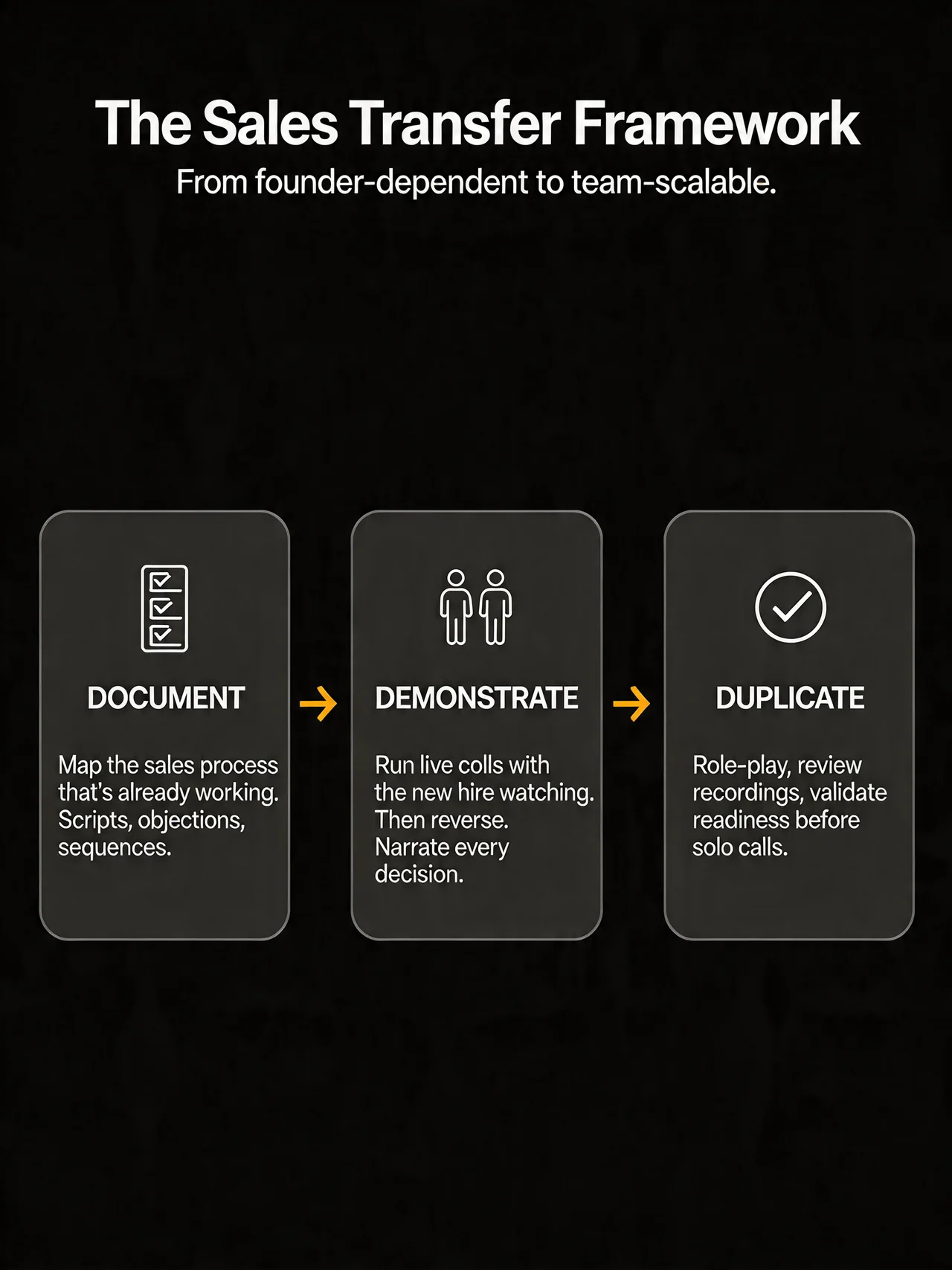
To stop the bleed of talent and opportunities, you must change the training approach. Move from passive observation to a strict, sequential three-step model: document the current process, demonstrate execution live, and duplicate results in a controlled environment before the rep speaks to a single prospect.
Phase 1: document the process (build the operations manual)
Before you even publish a job post or interview candidates, do the introspection: extract what you do instinctively on a call and turn it into an executable checklist. You don’t need a 100-page corporate manual. You need clear operating instructions for what happens at each micro-stage of your sales funnel.
Documenting means having exact written answers to critical questions: how you open discovery to take control in minute one; how you qualify (which questions, in what order, to confirm real pain + budget); how/when you present price; and how you respond to the top three objections in your market.
If you don’t document this first, the new rep will be forced to invent answers on the fly. Realistically, the odds their improvised answers are better than what you refined across years of rejection are near zero.
"💡 **Key Insight:** If you can’t write your current sales process as reproducible steps and checklists, you don’t have a process—you have an art. Art is personal and doesn’t scale. Processes do."
Phase 2: demonstrate live execution
Once the process is documented, it’s not enough to hand over the doc and wish them luck. You must empirically show how the checklist is executed in the real world—with real customers and real tension. This is where shadowing makes sense, with one crucial nuance: it must be active, never passive.
The rep doesn’t sit next to you just to “watch magic” in a demo or close. They should have the documented checklist in front of them and physically mark each step you take. They must audit you: when you ask the pain question, when you stay silent, when you isolate the financial objection.
Immediately after the call, do a joint debrief: “Why didn’t I ask this qualification question here?” or “How did I isolate the price objection before answering?” In practice, this aligns what’s on paper with cadence, pacing, and the exact tone you use to transmit authority and trust.
Phase 3: duplicate the outcome in a safe environment
This is the critical step where 90%+ of SaaS companies in Spain fail. They throw the rep into the line of fire to sell and handle real leads, mistakenly assuming they’re ready just because they read the doc and watched a few successful demos. Duplication requires the rep to run the process end-to-end in front of you, using the same documented material, until they achieve the same outcome and fluency.
And all of this must happen before you allow them to talk to a lead you paid money to acquire.
Intensive role-play and the certification barrier
At Miranda’s we call this phase “sales certification.” You play a difficult, skeptical prospect (your real ICP). The rep must run the full discovery call or demo, following the process precisely.
If they stumble, miss a transition, or fail to isolate an objection, you stop, correct, and restart. It doesn’t matter if you repeat role-play 15–20 times in a week. It’s infinitely cheaper to fix errors in the calm of the office than to lose a €15,000 deal in the real market because the rep couldn’t handle a qualification bottleneck.
Practical implementation: the first 30-day onboarding playbook
To make the three-phase model real (not theory), you need a strict, predictable onboarding calendar. This is the cadence we recommend to SaaS founders:
- **Days 1–5 (immersion + documentation):** the rep studies the ICP, market dynamics, and reads the sales process documentation. They listen to historical calls (wins and losses) and use the checklists to evaluate what went right/wrong.
- **Days 6–15 (active demonstration):** the rep shadows every sales call. Their job is to map your actions to the documented process and participate in post-call debriefs. They begin memorizing structural scripts and objection responses.
- **Days 16–30 (duplication + certification):** intensive practice in a safe environment. They role-play with you and technical team members. They must pass certification under pressure. Only then can they start taking real discovery calls, supervised at the beginning.
This method guarantees that when the rep starts managing real pipeline in month 2, they operate at your standard. Result: a drastic reduction in ramp time to profitability and higher long-term sales talent retention.
Summary and next step
- If you don’t document your sales process step-by-step, the new rep will invent their own—and the odds of failure are high.
- Demonstration must never be passive: the rep must actively audit your real calls against the checklist.
- Duplication requires rigorous role-play until internal fluency matches yours—long before touching real opportunities.
- To scale revenue without founder dependence, review our B2B lead generation services to professionalize your sales department.
- Support your team with AI process automation to reduce operational load.
- Review ONTSI research on how process standardization impacts SMB growth.
See also
Frequently asked questions
- How long should onboarding take?
- With Document→Demonstrate→Duplicate, the goal is: by day 30 the rep can qualify correctly; by days 60–90 they start closing autonomously while maintaining your conversion standard.
- Do I need to document every scenario?
- No. Document the 80% that happens 80% of the time: openings, qualification, pricing delivery, and top objections. Edge cases can be handled with support early on.
- What if a rep can’t pass role-play certification?
- Repeat practice and increase feedback. If they can’t reach a minimum standard after intensive role-play, it’s cheaper to stop before they burn real pipeline.
- Does this work if I’m still the only seller?
- Yes — it’s the best time. Documenting while you’re still closing is the prerequisite to hiring your first rep successfully.