When to hire a sales consultant for your startup
Almost every startup hits this point: the founder sells because they have to, but growth depends on their calendar. The question isn’t whether you need sales help. It’s when—and what kind of help—so you don’t burn cash.
Hire too early and you get movement without results. Hire too late and you become a structural bottleneck. At Miranda’s, the right decision usually comes down to a simple distinction: are you missing a system—or missing execution bandwidth?
This guide gives you a practical way to decide when to hire a sales consultant for a startup, which signals to use, and what to prepare so you can evaluate real impact in 30/60/90 days.
Core rule: clarity first, then speed
If your message is blurry, accelerating sales only accelerates rejection. A consultant adds value when they turn commercial clarity into repeatable execution.
If you can’t answer this in 20 seconds, wait
- Who you sell to (ICP)—and who you don’t.
- Which prioritized pain you solve today.
- What concrete outcome you promise—and how you prove it.
If this is hard to answer, you’re not late—you’re still validating. In that case, prioritise focus with the first customers plan for B2B SaaS.
Signals you should hire now
You don’t hire to avoid selling. You hire to install a system that reduces improvisation and founder dependency.
Stage-by-stage symptoms
- Generation: unstable pipeline, no clear dominant channel.
- Qualification: too many demos with low fit.
- Demo/close: high interest, low progression.
- Follow-up: no defined next step and no stable cadence.
The clearest signal
If nobody can keep sales running for a week without you, you need sales structure. That’s playbooks, CRM, and a weekly operating rhythm—not more sporadic effort.
"💡 **Key Insight:** If the founder is the only one who can sell, the problem isn’t talent. It’s the absence of a system."
Signals you should NOT hire yet
This is where most expensive mistakes are avoided. Without a minimum base, consulting can create activity without traction.
Common anti-signals
- You change segment and positioning every week.
- No prospect recognizes an urgent pain.
- Pricing and packaging have no repeatable criteria.
- You don’t know your cycle or basic conversion rates.
If this is your situation, validate focus and messaging hypotheses before scaling. Then connect this with the B2B SaaS sales process.
What to prepare before hiring (avoid wasted weeks)
A consultant without data can only give opinions. To execute seriously, they need operational evidence from day one.
Minimum prep checklist
- Current pipeline with stage + status per deal.
- Recent outbound/inbound messages and results.
- Call recordings or real call notes.
- Your current ICP definition and exclusion criteria.
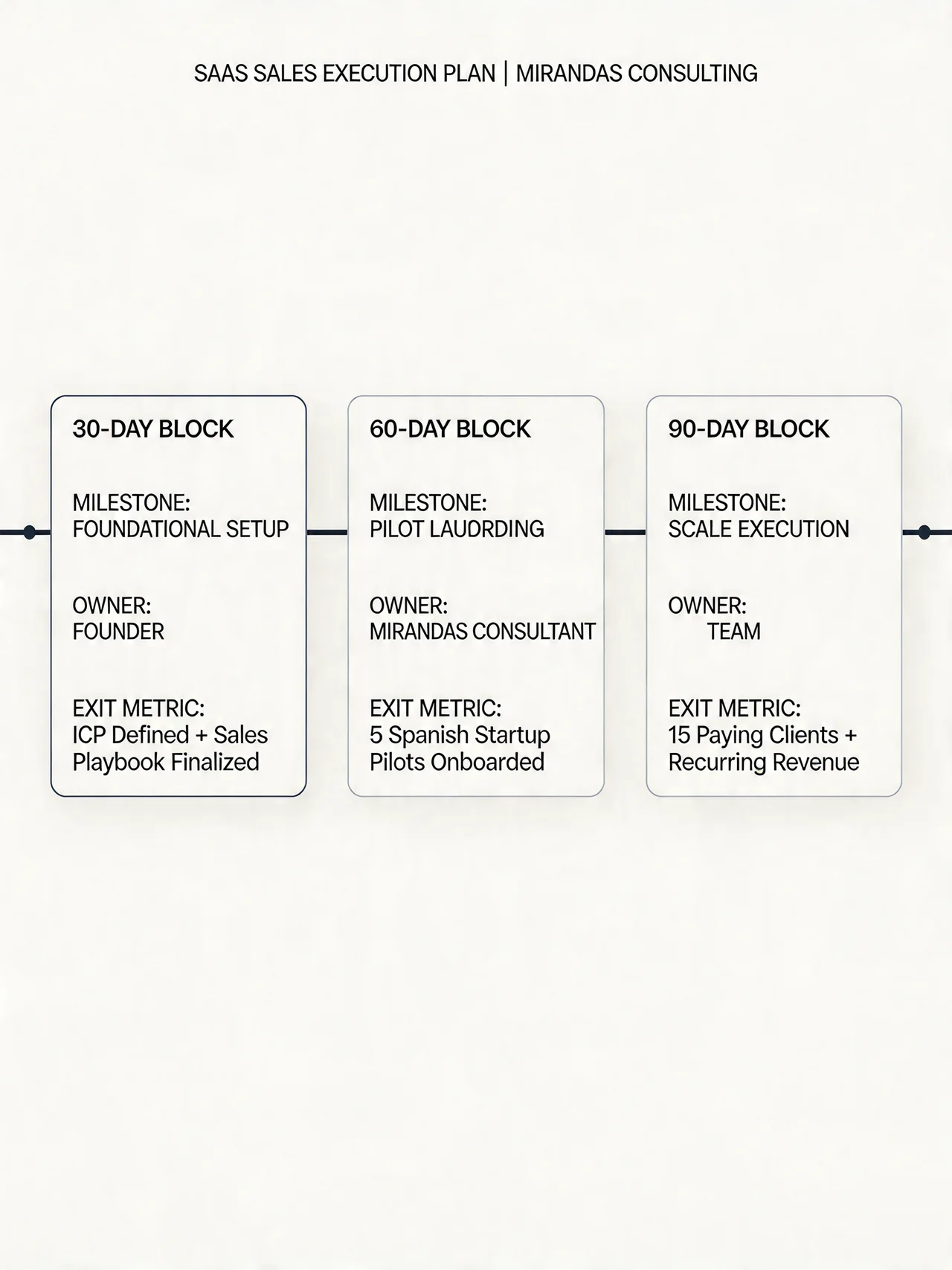
What to expect in 30/60/90 days
- 30 days: CRM order, defined stages, active cadences.
- 60 days: better filtering and more consistent stage progression.
- 90 days: basic predictability and transfer to the team.
"⚠️ **Watch Out:** If consulting doesn’t touch real calls and pipeline, the risk of “smoke” is high."
Summary and next step
Hire a consultant when you want to install a system—not when you’re hoping for a saviour. If you have early traction and operational chaos, the moment is usually now. If you don’t have customer focus yet, validate first and scale after.
A 10-minute decision
- Is there repeated, payable pain in a clear ICP?
- Is the founder already the sales bottleneck?
- Can you dedicate weekly time to implement changes?
- Do you have minimum data to work with evidence?
If you want to validate it against your real pipeline, request a free diagnosis and review our sales consulting.
Frequently asked questions
- When should I hire a sales consultant for a startup?
- When you already have fit signals and the bottleneck is the sales process: weak qualification, demos that don’t progress, follow-up without a system, and founder dependency. If you don’t have ICP focus yet, validate first before scaling with consulting.
- What should a consultant deliver in the first month?
- Stage definitions and metrics, structured discovery, a stronger demo approach, follow-up cadences, and an operational CRM. The key is real implementation in your operation—not just recommendations.
- How do I know if I need a consultant or to hire an SDR/AE?
- If the system is missing, start with consulting or sales leadership. An SDR fits when messaging is validated and you need more meeting volume. An AE fits when qualified pipeline exists and you need more closing capacity.
- How long until I see results?
- Operational signals often show in 2–4 weeks: more order, better filtering, and consistent follow-up. System consolidation usually takes 60–90 days. Revenue impact depends on your market’s sales cycle.
- What are red flags of a bad consultant?
- Fast promises without reviewing CRM or calls, no stage metrics, and a focus on documents without execution. If they don’t define a clear weekly review-and-improve routine, the risk of “smoke” is high.
- Does it make sense to hire a consultant if I’m 100% inbound?
- Yes. Even if leads come in, you still need a conversion system: speed-to-lead, qualification, demo, and follow-up. Without that sales layer, inbound underperforms.