How to allocate sales resources in B2B: the rule to avoid stalling your SaaS
How to allocate sales resources: the 70/20/10 rule to scale your B2B SaaS
We see it all the time at Miranda's. You have a SaaS product that works, B2B customers that pay and renew, but company growth has gone flat. Every month your sales pipeline looks like a blank page and, as founder or CEO, you spend your days chasing the latest tactic.
If one month cold email performance drops, the next week you try LinkedIn social selling. If product demos don’t close fast enough, you decide to pivot your ICP (Ideal Customer Profile) or radically change pricing.
The problem isn’t your product. It’s how you allocate your time, your team’s attention, and your budget. You’re over-innovating and under-executing.
If growth has stalled, and we’ll pinpoint where effort is leaking in your sales funnel.
Symptoms of poor sales resource allocation
In B2B SaaS there’s a dangerous obsession with finding the “magic formula”. When you miss quota, the instinct is to flip the table and search for a quick fix. When we analyze these situations, we always see the same three destructive patterns:
- The “New Tool Syndrome”: you buy annual licenses for Apollo, SalesNav and complex AI platforms, but your team has no standard qualification script.
- The “Dizzy SDR”: your sales team changes the outreach message every two weeks because someone heard a new podcast.
- A bloated but stuck pipeline: you get plenty of first meetings, but sales cycles drag on for months because every technical proposal is 100% custom.
This instability kills predictability. Industry data shows teams that follow a structured, repeatable process are 33% more likely to hit annual quota. If you constantly change operating variables, your customer acquisition costs (CAC) explode because you keep paying an endless learning tax.
"📥 **Free resource:** Not sure where opportunities leak or which part of the process actually works? Download our pipeline audit template and evaluate your foundation in 15 minutes."
The 70/20/10 model: a rule for protection and growth
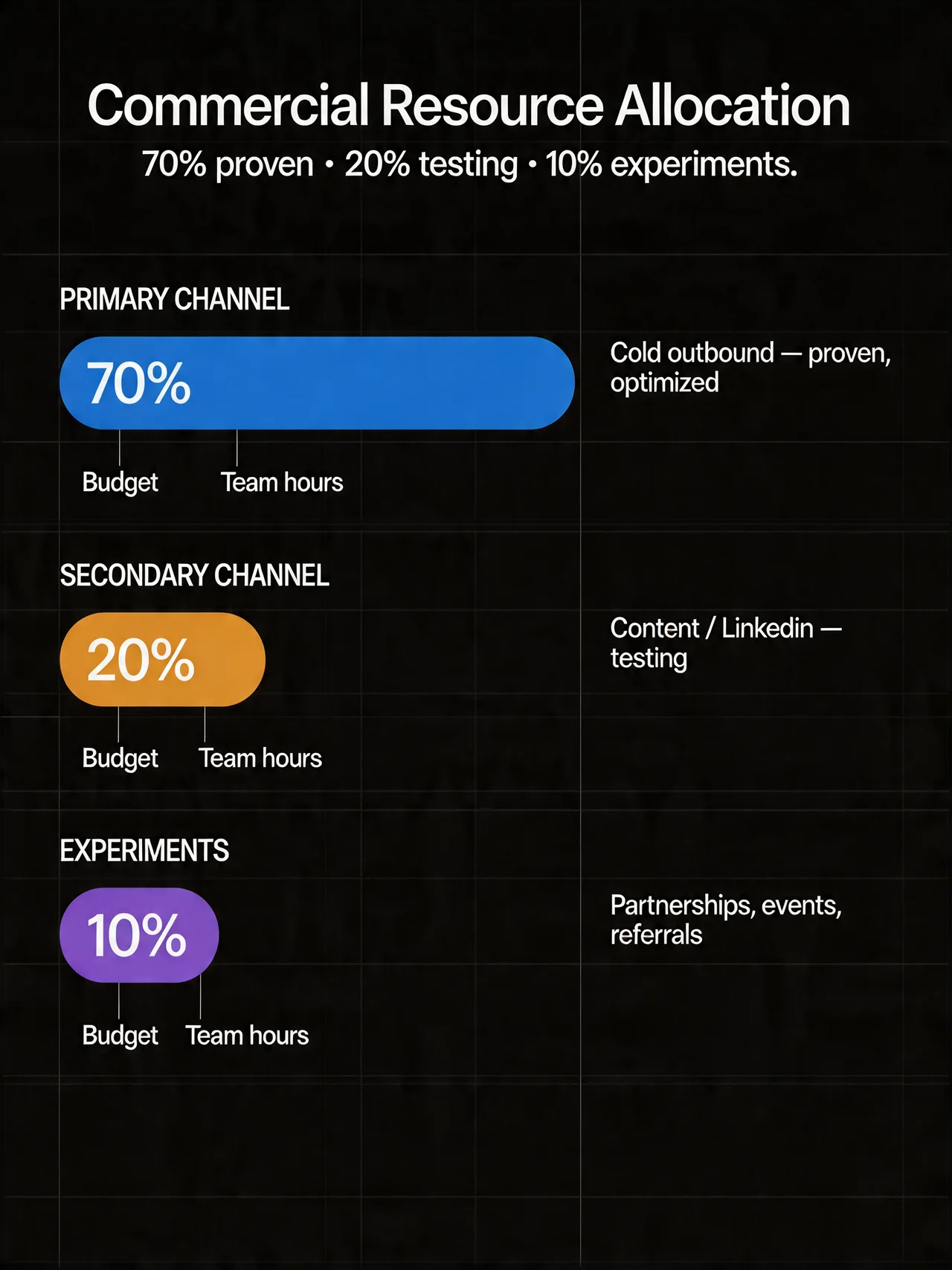
To keep financial stability while you pursue higher revenue, you need a strict discipline framework. Split your effort — your reps’ time, budget, and your own hours — into three non-negotiable buckets.
70% — The sales core (more of what already works)
Put 70% of your resources into cloning, repeating and ruthlessly optimizing what already makes you money. The goal is a baseline engine that pays payroll month after month without stress.
If you know that cold outreach to HR directors plus a phone follow-up two days later brings qualified demos, 70% of your focus must go into protecting that cadence. Don’t reinvent the wheel; document and delegate the process so it executes perfectly.
20% — Adjacent wins
Put 20% into controlled variations of the core. These bets are close to what you already master, with a small twist that lets you test new revenue paths safely.
If your core is selling software to tech companies in Madrid, your 20% bet could be using the same exact B2B outbound to target similar companies in Catalonia or Valencia. You’re innovating, but with a safety net.
10% — High-risk bets
Only 10% of your sales budget should go to truly disruptive ideas. These are channels that could transform your SaaS and produce outsized returns, but will almost certainly fail the first time.
Clear examples: testing a completely new enterprise segment, launching a partner ecosystem, or implementing an advanced AI-driven sales process automation. Capping this at 10% protects your cash.
"💡 **Key insight:** If your B2B SaaS is under €1M/year and you spend less than 70% of your energy on the predictable “Core”, you’re risking viability out of impatience."
How to apply the rule in your B2B sales cycle (90-day plan)
In practice, to break out of stagnation you should structure the next 3 months like this:
Days 1–30: Audit and protect your 70%
Measure everything from the last six months. Where did your five best customers come from? That channel is your core. Document the process step-by-step so any SDR can replicate it. Don’t start anything new until that engine is working.
Days 31–60: Systematize and launch the 20%
Once the core is almost on autopilot, take 20% of your sales budget and test one small variation. Adjust one angle of your pitch or add one extra step in the sequence. Measure conversion obsessively to see if it beats the original.
Days 61–90: The controlled 10% experiment
Only when baseline revenue is secured by the core should you run an aggressive campaign. Set a fixed budget (for example €1,000 and 15 hours in a month) for a brand-new channel. If the B2B market validates it, you’ll have a new long-term growth vector.
Summary and next step
Disciplined resource allocation is the main difference between a predictable B2B business and a monthly stress rollercoaster. Remember:
- Lock 70% of effort into channels with proven historical performance.
- Use 20% for safe variations of your offer or adjacent segments.
- Strictly cap high-risk experiments at 10% of time and sales budget.
- Learn to execute this discipline in our guide to the B2B SaaS sales process.
Ready to professionalize growth and stop relying on founder intuition? and we’ll evaluate your current bottlenecks.
Frequently asked questions
- What if I don’t have anything that works for my 70% yet?
- If you’re below €10k MRR and no channel is predictable, your only goal is manual, non-scalable selling until you find traction. Your 70% must be direct contact with your ICP, account by account, until you can close repeatable deals consistently.
- Can I spend more than 10% on innovation if I raise a funding round?
- Funding injects capital, not market certainty. Dramatically increasing experiment budget without consolidating your core only accelerates burn. Keep the discipline: prioritize the already-validated channel to grow safely.
- Who should own the 10% sales innovation in a B2B SaaS?
- In a team under 50 people, the founder or the direct sales leader should run these high-risk bets. They require fast operational decisions and there is no existing playbook, so you should not delegate these experiments to junior roles.
- How do I know if my 70% “Core” is still working?
- Monitor weekly conversion rates relentlessly. If lead-to-demo and demo-to-close rates stay stable, your core engine is healthy. If they decline for several consecutive weeks, it’s time to investigate and adjust the script.