Why your SaaS demos don’t convert (and how to fix it)
You run demos every week, the prospect seems interested, and you get the classic: “we’ll take a look and get back to you”. Then silence. If it happens repeatedly, it’s not a product problem—it’s a sales process problem at the most critical funnel stage.
At Miranda’s we see this pattern constantly in B2B SaaS: solid products and feature-heavy demos, but no pre-diagnosis, no value narrative, and no real next step. The result: lots of meetings, few closes, and a false sense of traction.
This guide gives you a clear diagnosis for why your demos don’t convert—and what to change this week. If you want the full framework, pair it with the B2B SaaS sales process.
Mistake 1: running demos without serious qualification
The biggest failure happens before the call. If you accept every demo request, you kill conversion from the start. Curiosity isn’t buying intent. A demo without a real problem, priority, or decision ability is wasted time.
- Is there current pain and a real cost of inaction?
- Are you speaking to someone who decides—or meaningfully influences the decision?
- Is there a realistic buying window?
- Does your solution fit their operational context?
"💡 **Key Insight:** Fewer demos, better qualified, usually produce more closes and less team burnout."
Mistake 2: turning the demo into a product tour
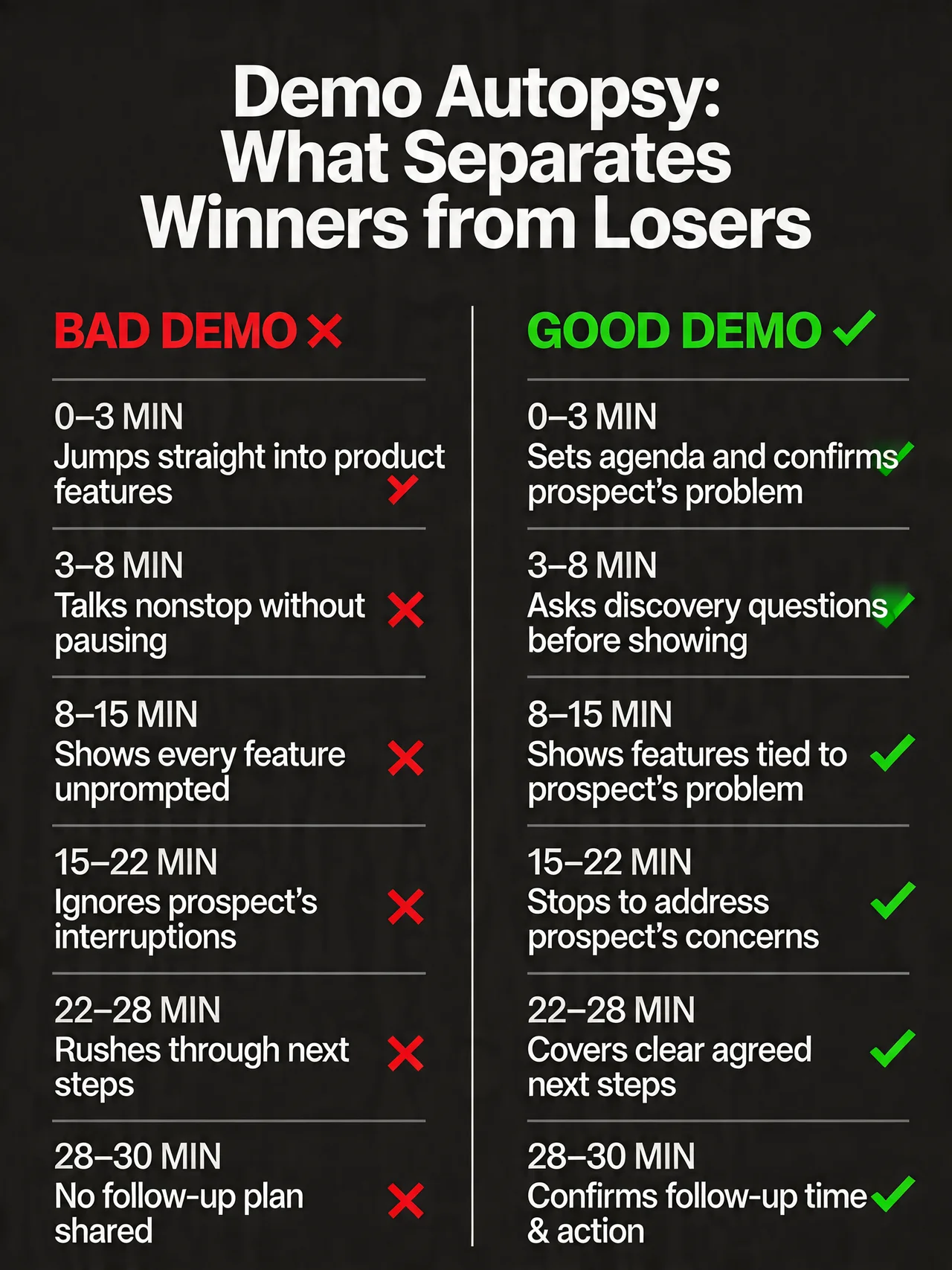
Customers don’t buy screens—they buy an outcome. When you walk through every feature, you overload them and lose focus. A demo should be a transformation story: current situation, problem impact, and proof of a solution.
A simple demo script that converts better
- Align agenda and business outcome in minute 1.
- Re-validate problem and urgency with discovery questions.
- Show only 2–3 use cases tied to the main pain.
- Confirm perceived value before you talk price or proposal.
- Close with a scheduled next step.
You can benchmark commercial patterns in HubSpot State of Sales.
Mistake 3: not involving the economic buyer
You can win the user and still lose the deal. In B2B SaaS, the person who controls budget or risk decides. If they’re not in the room, you need a business case your champion can defend internally.
- For the user: adoption ease and daily operational improvement.
- For leadership: economic impact, risk, and payback period.
- For technical teams: integration, security, and maintenance.
If you sell one narrative to every role, you get stuck in committee. Adapt your message by role and stage.
Mistake 4: ending without a scheduled next step
Ending with “I’ll send a proposal and you tell me” kills conversion. Momentum dies within 24 hours. Every demo should end with a scheduled action: decision-maker review, technical validation, or close.
If you want support here, use the demo closing library and define a post-demo cadence in your CRM.
"⚠️ **Watch Out:** Without a next step date, the opportunity is already at risk—even if the prospect says they love it."
Mistake 5: not feeding the process with data
If you don’t capture loss reasons per opportunity, you repeat mistakes. Conversion improves through a weekly learning system—not one brilliant line.
- Tag losses by real reason (price, timing, no-priority, no-fit).
- Review won/lost calls every week.
- Update script, objections, and enablement assets with evidence.
- Measure demo→proposal and proposal→close by segment.
To go deeper, connect this with B2B lead generation and the guide on founder-led sales bottlenecks.
Summary and next step
If your demos don’t convert, fix the order: strict qualification, value-led demo, involve the buyer, schedule the next step, and run weekly loss reviews. That raises conversion without depending on “more leads”.
Tomorrow’s checklist
- Define 4 mandatory qualification criteria.
- Cut your demo to 30 minutes with 2–3 use cases.
- Add a closing question to lock the next step.
- Review 10 past demos and tag the real non-close reason.
Frequently asked questions
- What’s a good demo-to-customer conversion rate in B2B SaaS?
- It depends on price point, segment, and sales cycle, but for SMB B2B SaaS a useful reference range is 20%–35%. If you’re below that, review qualification and the post-demo next step before changing pricing.
- How long should an ideal demo be?
- Typically 30–45 minutes depending on complexity. The key is structure: context and pain upfront, focused demonstration, and a close with a concrete action. A long, unfocused demo converts worse than a short, clear one.
- Should I share pricing in the first demo?
- It depends on your process and deal size. If there’s fit and clear value, a price range reduces friction and filters faster. If key inputs are missing, define scope first and then propose. The critical thing is not hiding price until the end without a reason.
- How fast will I see results if I fix my demos?
- You’ll usually see early signals in 2–4 weeks: higher demo→proposal conversion and fewer “ghost” opportunities. After 1–2 full sales cycles you can validate real impact on closes and pipeline predictability.
- What if the prospect asks me to 'send info' and won’t schedule a next step?
- Don’t end the call without attempting to schedule. Send a summary, but propose a concrete date to review with decision-makers. If they refuse, classify the deal as high-risk and run a follow-up cadence that adds value—not just reminders.
- How do I avoid demos depending on the founder?
- Document the script, qualification criteria, objection handling, and closing in a playbook. Then review calls weekly with the team. Consistency doesn’t come from charisma—it comes from system, training, and continuous feedback.
Rentabiliza: lead gen & positioning
- Marketing agency vs lead generation: what’s the difference?
Practical comparison for B2B SaaS: what each option solves, when to hire, and how to avoid investing in the wrong service.
- B2B lead generation in Spain: how to choose
Practical guide for SaaS founders and CEOs in Spain: when to hire B2B lead generation, what deliverables to demand, and how to evaluate real impact in 30/60/90 days.
- How much does B2B lead generation cost?
A realistic breakdown of B2B lead generation cost: what’s included, which variables drive price, and how to evaluate ROI without buying smoke.